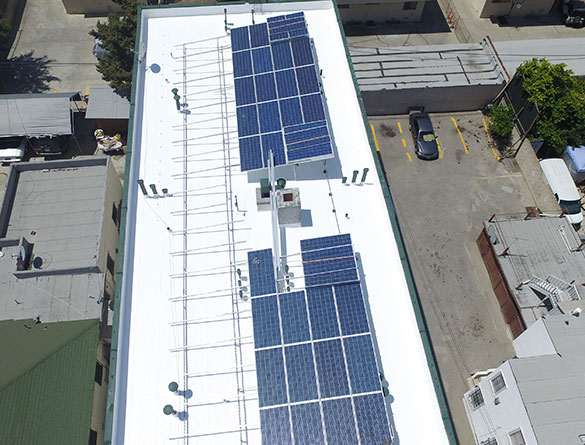
American High Tech Roof Coatings Inc. provides silicone roof coating services to commercial entities and property managers throughout West Covina and the surrounding San Gabriel Valley. This restoration method involves applying a high-solids silicone membrane over an existing roof structure. The process creates a seamless, water-tight barrier designed to correct structural degradation caused by age and environmental exposure.
Understanding Silicone Roof Restoration
Silicone roof coating acts as a restorative system rather than a cosmetic fix. It is a liquid-applied system that cures into a monolithic, rubber-like layer. This layer creates a seamless seal around penetrations, vents, and flashings, which are historically the most common points of failure on commercial flat roofs. For property owners, this serves as a preventative maintenance strategy that halts existing minor leaks and prevents future water intrusion.
Weather Considerations for West Covina Properties
West Covina experiences high temperatures and significant solar exposure throughout the year. Commercial roofs in this region absorb substantial heat, leading to thermal shock. Thermal shock occurs when a roof expands during the hottest part of the day and contracts rapidly as temperatures drop at night. This cycle causes seams to separate and materials to crack.
Silicone coatings possess high elasticity, allowing the membrane to expand and contract with the building structure without cracking. Furthermore, silicone is highly reflective. White silicone coatings reflect up to 88% of UV rays. This reflectivity reduces the surface temperature of the roof, which lowers the heat transfer into the building interior and reduces the workload on HVAC systems during West Covina summers.
Compatible Commercial Roof Substrates
Silicone coating allows for direct adhesion to a wide variety of existing roofing surfaces. American High Tech Roof Coatings Inc. evaluates adhesion requirements prior to application. The following substrates are generally suitable for silicone restoration:
- Modified Bitumen (Mod-Bit): Aged asphalt roofs often exhibit "alligatoring" or cracking. Silicone fills these voids.
- Single-Ply Membranes (TPO and EPDM): Weathered seams on TPO or EPDM can be sealed effectively.
- Built-Up Roofs (BUR): Gravel surfaces can be coated after proper preparation and spudding.
- Metal Roofs: Silicone prevents rust progression and seals fastening points and laps.
- Spray Polyurethane Foam (SPF): Silicone protects the foam from UV degradation.
Businesses and Buildings Suited for Restoration
Large-scale commercial and industrial facilities benefit most significantly from this application due to the square footage involved. The non-disruptive nature of the installation makes it ideal for occupied buildings.
- Warehouses and Distribution Centers: These facilities often have large surface areas where cooling costs are a major expense.
- Retail Shopping Centers: Business continuity is maintained as there are no loud tear-off noises or hazardous fumes.
- Office Parks and Medical Buildings: The low-odor application allows tenants to remain undisturbed.
- Multi-Unit Residential Complexes: Property managers can restore roofs without coordinating tenant displacement.
Extending Roof Life by 20 Years
A properly installed silicone coating system extends the service life of an existing roof by 10 to 20 years, depending on the thickness of the application (measured in mils). Once the warranty period concludes, the roof can typically be power washed and recoated with a new layer of silicone. This renewability allows American High Tech Roof Coatings Inc. to maintain the roof indefinitely without ever requiring a full tear-off, provided the substrate remains dry and stable.
Cost Comparison: Coating vs. Re-Roofing
Re-roofing requires the complete removal of the existing roof system, which is labor-intensive and generates significant landfill waste. Silicone coating utilizes the existing insulation and deck, removing only wet areas. The following table outlines the comparative differences for a standard commercial project.
| Factor | Silicone Roof Coating | Traditional Tear-Off & Replacement |
|---|---|---|
| Material Cost | Lower (Liquid applied) | High (New insulation, membrane, fasteners) |
| Labor Intensity | Low (Cleaning and Spraying/Rolling) | High (Demolition and Installation) |
| Disposal Fees | Minimal to None | High (Dumpster and Landfill fees) |
| Installation Time | Days | Weeks |
| Building Permit Cost | Generally Lower | Higher |
Cost Benefit Analysis
Property owners analyzing the return on investment for roof restoration should consider both immediate capital output and long-term operational savings. Silicone coating generally costs 50% to 70% less than a full roof replacement. Beyond the upfront savings, the energy efficiency gains contribute to lower monthly utility bills.
Additionally, the entire cost of a roof restoration project can often be classified as a maintenance expense for tax purposes, allowing for immediate deduction in the current tax year. In contrast, a roof replacement is typically considered a capital improvement that must be depreciated over 39 years. Property owners should consult with their tax professionals to confirm eligibility for their specific situation.