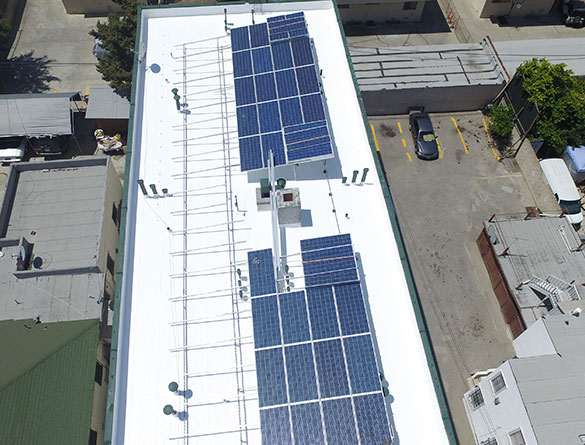
Property owners and facility managers in Temple City face specific challenges regarding commercial roof maintenance. The local climate, characterized by intense solar exposure and seasonal rainfall, places significant stress on flat and low-slope roofing systems. American High Tech Roof Coatings Inc. provides silicone roof coating services designed to address these environmental factors while offering a viable alternative to complete roof replacement.
Silicone Roof Coating, also known as silicone restoration, is a fluid-applied system that cures into a seamless, durable, and waterproof membrane over an existing roof structure. This text outlines technical considerations, cost benefits, and application parameters for Temple City commercial properties.
Weather Considerations for Temple City Roofs
The San Gabriel Valley microclimate impacts roofing materials primarily through UV radiation and thermal cycling. Traditional roofing materials like asphalt or black TPO absorb heat, causing the roof surface temperature to rise significantly above ambient air temperature. This heat absorption leads to thermal expansion and contraction, which eventually separates seams and causes flashings to fail.
Silicone coatings offer high solar reflectivity. By reflecting the majority of the sun's UV rays, the roof surface remains cooler. This reduces the mechanical stress caused by thermal shock. Furthermore, silicone is chemically stable and does not degrade under prolonged UV exposure, unlike acrylic coatings or asphalt-based products.
Regarding moisture, Temple City experiences distinct wet seasons. Flat roofs often suffer from ponding water, defined as water that remains on a roof 48 hours after rainfall. Silicone is inorganic and moisture-cured, meaning it does not break down or emulsify when subjected to standing water. This makes it the standard solution for roofs with imperfect drainage.
Which Roofs Are Best for Silicone Coating?
Silicone coating is a versatile restoration method, but it requires a sound underlying substrate. It is effective for the following commercial roof types found throughout Temple City:
- Modified Bitumen (Mod-Bit): Silicone seals the granulated surface and prevents further drying or cracking of the asphalt.
- Single-Ply Membranes (TPO, PVC, EPDM): As these membranes age and weather, silicone restores their waterproofing integrity and covers exposed scrim or shrinking seams.
- Built-Up Roofs (BUR): Smooth-surface BUR systems are excellent candidates for restoration.
- Metal Roofs: Silicone encapsulates fasteners and seams, which are the primary failure points on metal roofs, and stops rust inhibiton.
- Spray Polyurethane Foam (SPF): Silicone is the required protective coating for SPF roofing systems to prevent UV degradation.
Businesses and Buildings Suited for Restoration
The application process for silicone coating is non-intrusive, making it suitable for businesses that cannot afford operational downtime. American High Tech Roof Coatings Inc. recommends this solution for:
- Retail Shopping Centers: Restoration generates minimal noise and no fumes, allowing retail operations to continue without disturbing customers.
- Cold Storage and Warehouses: The reflective nature of the coating reduces the internal temperature, lowering the load on HVAC and refrigeration systems.
- Office Buildings: There is no risk of exposing the building interior to the elements during the project, protecting sensitive equipment and documents.
- Medical Facilities: The low-VOC (Volatile Organic Compounds) nature of high-solids silicone allows for application near intake vents without impacting indoor air quality.
Comparison: Silicone Coating vs. Re-Roofing
Property managers must often decide between restoring a roof or performing a complete tear-off and replacement. The following table illustrates the operational differences between silicone restoration and traditional re-roofing.
| Factor | Silicone Roof Coating | Traditional Re-Roofing |
|---|---|---|
| Cost | Typically 50% to 70% lower cost per square foot. | High labor and material costs. |
| Project Duration | Fast application; usually completed in days. | Lengthy process taking weeks or months. |
| Waste Disposal | Zero landfill waste. | Requires dumpsters for tons of old material. |
| Building Exposure | Building remains fully sealed during work. | Interior exposed to weather during tear-off. |
| Permitting | Often classified as maintenance (faster approval). | Requires complex building permits and inspections. |
Cost Benefit Analysis
Investing in silicone roof coating provides immediate and long-term financial advantages. The initial project cost is lower because it utilizes the existing insulation and deck, removing the labor-intensive tear-off phase. American High Tech Roof Coatings Inc. identifies three primary financial benefits:
- Energy Reduction: The "Cool Roof" properties of silicone reduce roof surface temperatures by up to 50 degrees Fahrenheit. This reduction transfers less heat into the building, lowering air conditioning energy consumption during Temple City summers.
- Tax Classification: Roof restoration is frequently classified as a maintenance expense rather than a capital improvement. Under current tax codes, maintenance expenses can often be deducted immediately in the tax year they occur, whereas capital improvements must be depreciated over 39 years. (Consult a tax professional for verification).
- Extended Asset Life: Restoration defers the massive capital expenditure of a full roof replacement, preserving cash flow for other business operations.
Longevity: Extend the Life of Your Roof by 20 Years
A properly installed silicone system by American High Tech Roof Coatings Inc. functions as a monolithic, seamless barrier. The longevity of the system correlates directly to the thickness of the application, measured in mils. Manufacturers offer material and labor warranties ranging from 10 to 20 years depending on the amount of material applied.
Once the warranty period expires, a silicone roof can often be cleaned and re-coated with a new layer of silicone to renew the warranty. This cycle allows property owners to maintain the same roof substrate indefinitely, assuming the structure remains sound. A 20-year extension provides a secure waterproofing solution that withstands the specific environmental demands of Temple City.