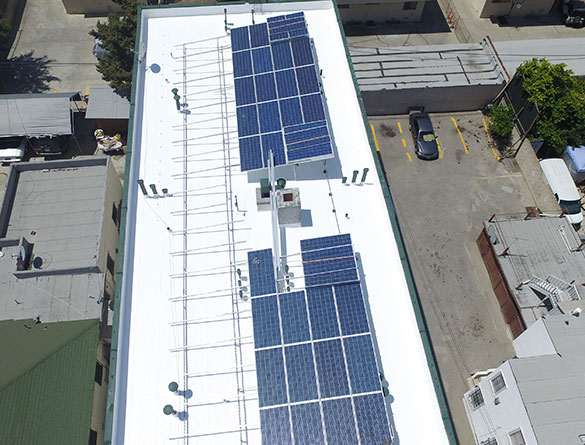
American High Tech Roof Coatings Inc. provides commercial silicone roof restoration services for property managers and building owners in South Gate, California. Silicone roof coating involves the application of a high-solids silicone membrane over an existing roof structure. This process creates a seamless, water-tight barrier that addresses leaks and surface degradation without the need for a complete roof tear-off. This guide outlines the technical specifications, economic implications, and performance metrics of silicone systems for commercial facilities.
Suitable Roof Types for Silicone Restoration
Silicone coatings are engineered to adhere to a wide variety of existing roof substrates. The chemical composition of silicone allows for application on flat and low-slope roofs where ponding water is a concern. American High Tech Roof Coatings Inc. applies silicone systems to the following substrates:
- Metal Roofs: Addresses rust, seam separation, and fastener backing.
- Single-Ply Membranes: Compatible with aged TPO (Thermoplastic Polyolefin), EPDM (Rubber), and PVC roofs.
- Modified Bitumen: Seals granulated surfaces and prevents further asphalt degradation.
- Built-Up Roofing (BUR): Encapsulates gravel and smooth-surfaced asphalt roofs.
- Spray Polyurethane Foam (SPF): Renews the UV protection layer on existing foam roofs.
Ideal Commercial Candidates in South Gate
The industrial and commercial density of South Gate makes silicone restoration a practical solution for specific building types. Large-scale facilities often possess expansive flat roofs where full replacement causes significant operational disruption. The following facilities are well-suited for this restoration method:
- Industrial Warehouses: Buildings requiring temperature control benefit from the reflective properties of silicone.
- Manufacturing Plants: Facilities that cannot afford downtime associated with open roof decks during replacement.
- Retail Shopping Centers: Properties requiring minimal noise and odor disturbance during maintenance.
- Office Complexes: Buildings seeking to reduce HVAC loads and improve energy efficiency.
Silicone Coating Versus Full Roof Replacement
Property owners often weigh the decision between restoring an existing roof and commissioning a full tear-off and replacement. Silicone coating is categorized as a restoration or maintenance activity, whereas re-roofing is a capital improvement. This distinction impacts the budget and timeline of the project.
Cost Savings: A silicone coating system typically costs 50% to 70% less than a complete roof replacement. This reduction stems from the elimination of demolition labor, landfill fees for disposal, and the purchase of insulation and decking materials.
Operational Continuity: Applying a silicone coating is less invasive than replacement. The existing roof remains in place, meaning the building remains water-tight throughout the application process. Operations inside the building continue without the noise and safety hazards associated with heavy construction.
Cost Benefit Analysis: Coating vs. Replacement
The following table illustrates the comparative differences between installing a silicone restoration membrane and opting for a traditional roof replacement.
| Comparison Factor | Full Roof Replacement | Silicone Roof Coating |
|---|---|---|
| Average Cost | High ($8.00 - $15.00+ per sq. ft.) | Moderate ($2.50 - $5.00 per sq. ft.) |
| Installation Time | Weeks to Months | Days to Weeks |
| Waste Disposal | High volume (Old materials sent to landfill) | Zero to Minimal waste |
| Tax Treatment | Capital Expenditure (Depreciated over 39 years) | Maintenance Expense (Often fully deductible in year 1) |
| Building Disruption | High (Noise, dust, potential exposure) | Low (Quiet application, low odor) |
South Gate Weather and Environmental Considerations
Roofs in South Gate are subject to specific environmental stressors, primarily high UV exposure and thermal cycling. Silicone offers distinct advantages in this climate.
UV Stability: Traditional asphalt-based roofs degrade rapidly under constant sunlight, leading to cracking and brittleness. Silicone is inorganic and UV-stable. It does not chalk or degrade under harsh ultraviolet rays, maintaining its flexibility over time.
Reflectivity and Energy Efficiency: Silicone coatings are typically bright white. They reflect up to 88% of the sun's UV rays. This reflectivity lowers the surface temperature of the roof significantly compared to a black roof. Reduced roof temperatures transfer less heat into the building, lowering cooling costs during the warm months common in Southern California.
Ponding Water Resistance: Flat roofs in the area may accumulate water due to lack of slope. Unlike acrylic coatings, which can re-emulsify or peel under standing water, silicone is a moisture-cure chemistry that withstands permanent ponding water without breaking down.
Extending Roof Life by 20 Years
American High Tech Roof Coatings Inc. utilizes high-solids silicone that can extend the service life of an existing roof by up to 20 years. The longevity of the system depends on the thickness of the application, typically measured in mils.
Once the warranty period of a silicone roof expires, the roof can often be cleaned and recoated with a new layer of silicone. This renewability allows the roof system to be maintained indefinitely, provided the underlying structure remains sound. This cycle prevents the roof from ever entering a landfill, providing a sustainable, long-term roofing strategy for property owners.