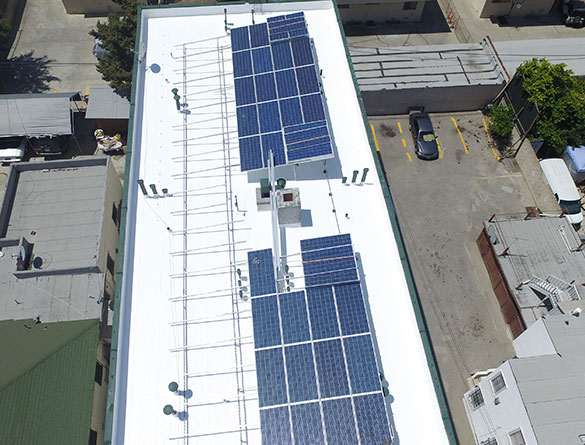
Property owners and managers in Rolling Hills Estates face specific challenges regarding commercial roof maintenance. The combination of high UV exposure and the requirement for strictly maintaining property aesthetics necessitates roofing solutions that are durable and visually unobtrusive. American High Tech Roof Coatings Inc. provides silicone roof coating services designed to restore existing roof substrates without the intrusiveness of full construction.
Silicone roof coating, also known as spray polyurethane foam (SPF) coating or restoration membrane, is a fluid applied system. When cured, it forms a seamless, monolithic layer over the existing roof. This process halts leaks, resists ponding water, and reflects solar heat, resulting in stabilized interior temperatures.
Commercial Roofs Best Suited for Silicone Coating
Silicone coatings are chemically formulated to adhere to a wide variety of existing roof surfaces. This versatility makes the application a viable option for most commercial buildings in the Rolling Hills Estates area. American High Tech Roof Coatings Inc. evaluates the adhesion potential for the following substrates:
- Modified Bitumen (Mod-Bit): Silicone seals the seams and prevents the granulation loss common in aging bitumen roofs.
- Single-Ply Membranes (TPO and EPDM): As these membranes weather, they shrink and crack. Silicone fills these micro-cracks and provides a new waterproof layer.
- Built-Up Roofs (BUR): The coating encapsulates the gravel and asphalt, stopping the degradation caused by UV rays.
- Metal Roofs: Silicone prevents rust and seals fasteners and seams, which are the primary failure points on metal systems.
- Spray Polyurethane Foam: Silicone creates a protective shell over existing foam insulation.
Businesses and Buildings Best Suited for Restoration
The application process for silicone coating is low-noise and low-odor compared to traditional tar or torch-down applications. This makes it appropriate for occupied buildings where business continuity is required. In Rolling Hills Estates, the following facility types benefit most from this restoration method:
- Medical and Dental Offices: The lack of fumes allows healthcare providers to remain open during application.
- Retail Centers: Installation does not require heavy equipment blocking parking lots or customer access points.
- Equestrian Facilities and Barns: The non-toxic nature of the cured product and the temperature reduction capabilities are beneficial for livestock housing.
- Homeowners Association (HOA) Common Buildings: The clean aesthetic and long warranties align with HOA management requirements.
Weather Considerations in Rolling Hills Estates
The local climate dictates specific performance requirements for roofing materials. Rolling Hills Estates experiences intense solar radiation during the day and rapid cooling at night, leading to thermal shock. Thermal shock causes roofing materials to expand and contract, eventually leading to seam separation.
Silicone remains flexible indefinitely. It expands and contracts with the building structure without cracking. Furthermore, flat roofs in this region often suffer from ponding water due to lack of slope or drainage issues. Silicone is an inorganic material, meaning it does not break down or deteriorate when subjected to standing water. It provides a waterproof seal that remains intact even if water remains on the roof for more than 48 hours.
Cost Benefit Analysis: Restoration vs. Replacement
Budgeting for roof maintenance requires comparing the immediate capital expense of replacement against the maintenance cost of restoration. The following table outlines the financial and operational differences between applying a silicone coating system and performing a complete roof tear-off and replacement.
| Cost Factor | Silicone Restoration | Traditional Tear-Off & Replacement |
|---|---|---|
| Material Cost | Lower. Requires coating and primer only. | Higher. Requires insulation, membrane, fasteners, and flashing. |
| Labor Cost | Minimal. Applied via spray or roller with a small crew. | High. Requires demolition, disposal, and installation crews. |
| Disposal Fees | None. Existing material stays in place. | Significant. Landfill fees for old roofing materials are costly. |
| Tax Treatment | Often classified as Maintenance (fully deductible in year 1). | Classified as Capital Improvement (depreciated over 39 years). |
| Energy Savings | High reflectivity reduces HVAC load immediately. | Varies based on insulation R-value added. |
Cheaper Than Re-Roofing
Replacing a commercial roof involves tearing off the existing materials, transporting debris to a landfill, and purchasing entirely new decking, insulation, and membranes. This process is labor-intensive and subject to fluctuating material costs.
Silicone coating eliminates the demolition phase entirely. American High Tech Roof Coatings Inc. cleans the existing roof, repairs minor defects, and applies the coating directly to the surface. This reduction in labor and waste disposal results in a project cost that is typically 50% to 70% lower than a full roof replacement. Additionally, because the existing insulation is reused, the building maintains its thermal efficiency without the cost of new insulation boards.
Longevity: Extend the Life of Your Roof by 20 Years
A properly installed silicone roof coating system extends the service life of an existing roof by up to 20 years. The coating creates a sacrificial layer that absorbs the weathering elements that would otherwise destroy the underlying membrane.
The longevity of the system is tied to the thickness of the application, usually measured in mils. American High Tech Roof Coatings Inc. offers different warranty structures based on the thickness applied:
- 10-Year Warranty: Standard application thickness.
- 15-Year Warranty: Increased thickness for higher durability.
- 20-Year Warranty: Maximum thickness for long-term protection.
Once the warranty period expires, the roof can typically be washed and recoated to renew the warranty, further extending the roof's life indefinitely without ever requiring a full tear-off.