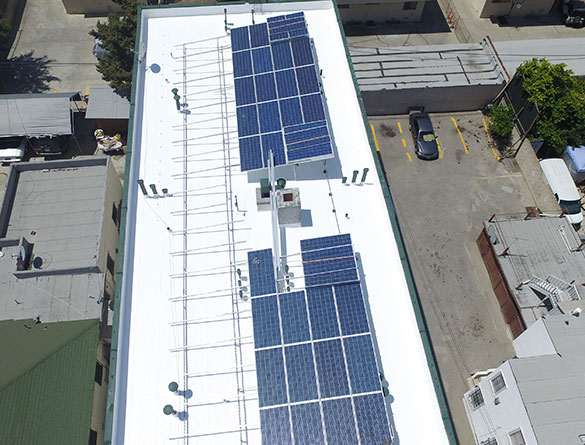
Silicone roof coating, often referred to as a Silicone Restoration Membrane (SRM), allows commercial property owners to restore an existing roof without the expense and disruption of a complete tear-off. American High Tech Roof Coatings Inc. provides this service to extend the lifespan of commercial roofing systems in Montebello. This process involves applying a high-solids silicone material directly over the existing roof surface, creating a seamless, waterproof barrier that withstands local weather conditions and industrial wear.
Suitable Roof Types for Silicone Coating
Silicone coatings adhere effectively to a wide range of commercial roofing substrates. The material is chemically formulated to bond with existing surfaces, provided they are properly cleaned and primed. The following roof types are excellent candidates for silicone restoration:
- Metal Roofs: Silicone seals seams and fasteners, preventing rust and leaks common in aging metal structures.
- Modified Bitumen (Mod-Bit): Granulated or smooth surfaces can be coated to stop degradation caused by UV exposure.
- Single-Ply Membranes (TPO and EPDM): Weathered membranes that are shrinking or cracking can be restored.
- Built-Up Roofs (BUR): Gravel and asphalt roofs can be sealed to lock in loose aggregate and waterproof the surface.
- Spray Polyurethane Foam (SPF): Silicone protects the foam from UV damage and physical deterioration.
Commercial Applications in Montebello
Montebello contains a dense concentration of industrial warehouses, distribution centers, and retail strip malls, particularly in the industrial corridors south of Washington Boulevard and along Whittier Boulevard. These structures often feature large, flat roofing systems that are difficult and costly to replace.
American High Tech Roof Coatings Inc. recommends silicone restoration for:
- Industrial Warehouses: Facilities requiring temperature control benefit significantly from the reflective properties of silicone.
- Retail Centers: Businesses that cannot afford operational downtime during roofing projects find coating less intrusive than replacement.
- Office Buildings: Property managers seeking to lower Common Area Maintenance (CAM) charges through reduced energy costs.
- Manufacturing Plants: Buildings subject to chemical exhaust or specific environmental stressors.
Cost Benefit Analysis
The financial advantages of silicone roof coating manifest in immediate project savings and long-term operational reductions.
Direct Project Savings: Silicone restoration typically costs 50% to 70% less than a full roof replacement. This reduction stems from lower labor requirements and the elimination of landfill fees associated with tearing off old materials.
Energy Efficiency: Silicone coatings are highly reflective and solvent-free. By reflecting up to 88% of the sun's UV rays, these "cool roofs" reduce roof surface temperatures by as much as 50 degrees Fahrenheit. This directly lowers the workload on HVAC systems, leading to reduced electricity bills. This is particularly relevant for complying with California Title 24 energy standards.
Tax Incentives: Because roof restoration is classified as maintenance rather than a capital improvement, the entire cost can often be expensed in the year it is incurred under Section 179 of the IRS tax code, rather than depreciated over 39 years.
Comparison: Silicone Restoration vs. Total Re-Roofing
Property owners facing a leaking or aging roof must decide between restoration and replacement. The following table outlines the operational differences between applying a silicone coating and commissioning a full re-roof.
| Feature | Silicone Roof Coating | Full Roof Replacement |
|---|---|---|
| Cost | Low (Maintenance Expense) | High (Capital Expenditure) |
| Installation Time | Fast application; minimal disruption | Lengthy process; significant noise/debris |
| Waste Disposal | Zero landfill waste | Tons of waste sent to landfills |
| Business Operations | Business remains open | Risk of closure or limited access |
| Waterproofing | Seamless, monolithic membrane | Seams are potential failure points |
Weather Considerations for Montebello
Montebello experiences hot, dry summers and periodic heavy rainfall in winter. These conditions create specific challenges for roofing systems that silicone addresses effectively.
UV Stability: Standard asphalt roofs absorb heat and degrade rapidly under intense Southern California sunlight. Silicone is inorganic, meaning it does not break down under UV rays. It maintains its flexibility and adhesion properties despite long-term sun exposure.
Ponding Water Resistance: Flat roofs often develop low spots where water accumulates. Unlike acrylic coatings, which can re-emulsify or peel under standing water, silicone is moisture-cured and completely non-porous. It withstands ponding water without deteriorating, making it a reliable solution for flat roofs with imperfect drainage.
Longevity and Extended Life
A properly installed silicone roof coating system extends the life of an existing roof by 10 to 20 years. American High Tech Roof Coatings Inc. provides warranties that cover material and labor for these durations.
The system is also renewable. At the end of the warranty period, the roof can be pressure washed and recoated with a new layer of silicone to extend the warranty for another 10 to 20 years. This cycle can be repeated, potentially deferring the need for a full tear-off indefinitely while maintaining a watertight, energy-efficient building envelope.