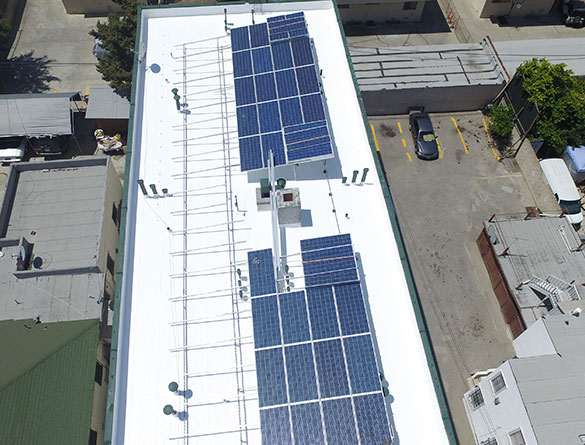
Commercial property owners in Lawndale seeking to address aging roof systems often face the decision between a complete tear-off or a restoration strategy. American High Tech Roof Coatings Inc. provides silicone roof coating services designed to restore the waterproofing capabilities of existing substrates without the need for invasive construction. This process, often referred to as a fluid-applied restoration, creates a seamless, monolithic membrane over the existing roof structure. This text outlines the technical specifications, financial implications, and performance metrics of silicone roof systems for Lawndale facilities.
Restoration vs. Replacement: A Technical Comparison
Silicone coating is classified as a maintenance or restoration activity rather than a new construction project. This distinction impacts cost, waste generation, and facility downtime. The following table compares a standard silicone restoration against a traditional full roof replacement.
| Factor | Silicone Roof Restoration | Full Roof Replacement |
|---|---|---|
| Cost Efficiency | Typically costs 50% to 70% less per square foot. | High labor and material costs for demolition and installation. |
| Business Disruption | Minimal noise; business operations continue uninterrupted. | Significant noise, heavy equipment, and potential closures. |
| Landfill Waste | Near-zero waste generation. | Tons of roofing material sent to landfills. |
| Installation Speed | Rapid application via spray or roll methods. | Lengthy process involving tear-off and multi-layer installation. |
| Permitting | Often considered maintenance; fewer permit hurdles. | Requires complex building permits and inspections. |
Cost Benefit Analysis of Silicone Systems
The financial advantages of silicone coating extend beyond the immediate reduction in installation costs. American High Tech Roof Coatings Inc. advises property managers to consider the Total Cost of Ownership (TCO) when evaluating this system.
- Tax Classification: Because roof coating is classified as maintenance, the entire cost can often be expensed in the year the work is performed. In contrast, a roof replacement is a capital improvement that must be depreciated over 39 years.
- Energy Reduction: Silicone is highly reflective and UV stable. It reflects up to 90% of the sun's UV rays, preventing heat transfer into the building. This reduces the load on HVAC systems, leading to lower monthly cooling costs during the warm Lawndale summers.
- Reduced Maintenance: Once cured, the silicone membrane is resistant to biological growth, staining, and impact, reducing the frequency and cost of ongoing roof repairs.
Substrates and Roof Types Suited for Silicone
Silicone technology relies on adhesion. While versatile, it requires a structurally sound substrate to function correctly. American High Tech Roof Coatings Inc. performs adhesion tests to ensure compatibility. The following roof types are generally excellent candidates for silicone restoration:
- Metal Roofs: Silicone arrests rust and seals seams and fasteners, which are common failure points on metal roofs.
- Single-Ply Membranes (TPO and EPDM): As these membranes age and crack, silicone fills the micro-fissures and creates a new protective layer.
- Modified Bitumen and Built-Up Roofs (BUR): Silicone caps these granular surfaces, stopping the degradation of the bitumen caused by UV exposure.
- Spray Polyurethane Foam (SPF): Silicone is the standard protective coating for SPF roofs to prevent UV degradation of the foam.
Weather Considerations in Lawndale
The climate in Lawndale presents specific challenges that silicone is engineered to handle. The region experiences high solar exposure throughout the year. Traditional asphalt-based roofs absorb this heat, leading to thermal shock, the expansion and contraction of roofing materials that eventually causes seams to split. Silicone remains flexible indefinitely and does not crack under thermal stress.
Furthermore, silicone is unique among roof coatings because it is moisture-cured and non-sacrificial. It does not degrade or break down when subjected to standing water. For flat commercial roofs in Lawndale that may experience ponding water after seasonal rains, silicone provides a permanent barrier that resists hydrostatic pressure. Acrylic coatings, by comparison, often emulsify or peel under standing water conditions.
Extend the Life of Your Roof by 20 Years
The application of a high-solids silicone coating can extend the service life of an existing roof by up to two decades. American High Tech Roof Coatings Inc. tailors the warranty length based on the thickness of the application, measured in mils.
- Material Stability: Silicone is inorganic, meaning it does not break down under UV light like organic asphalt materials. It maintains its physical properties over time.
- Renewability: At the end of the warranty period (typically 10, 15, or 20 years), the roof can be cleaned and recoated with a new layer of silicone. This resets the warranty and further extends the roof's life without ever requiring a tear-off.
- Seamless Protection: The primary cause of leaks is seam failure. By creating a monolithic layer, silicone eliminates seams entirely, removing the most vulnerable aspect of a commercial roof.
Suitable Businesses and Buildings
Silicone roof coating is appropriate for a wide variety of commercial and industrial structures found throughout Lawndale. Building owners prioritize this solution when internal operations are sensitive to leaks or temperature fluctuations.
Warehouses and Distribution Centers: These facilities often have large square footage where cooling costs are significant. The reflective nature of silicone aids in temperature control for inventory protection.
Retail Centers and Strip Malls: Disruption to tenants during a re-roofing project can lead to revenue loss. Silicone application is quiet and low-odor, allowing retail shops to remain open during the project.
Office Buildings and Medical Facilities: Protecting sensitive equipment and maintaining a professional environment is critical. The seamless nature of the coating offers reliable leak protection for critical infrastructure.