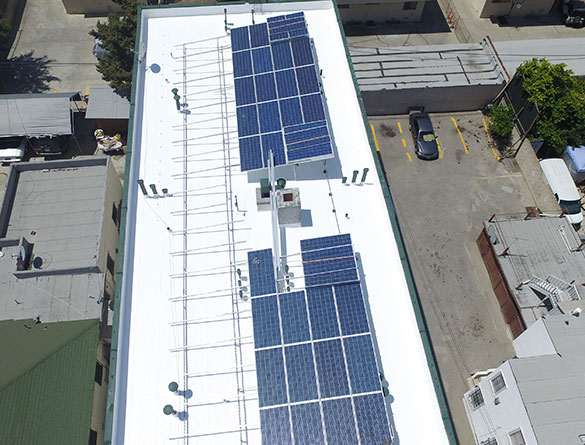
Commercial property owners and managers in La Verne face specific challenges regarding roof maintenance. The local climate, characterized by high ultraviolet exposure and variable temperatures, accelerates the degradation of traditional roofing materials. Silicone roof coating offers a restoration solution that addresses these environmental factors without the need for a complete tear-off. American High Tech Roof Coatings Inc. provides this service to extend the service life of existing commercial roofing systems.
A silicone roof coating system involves applying a high-solids silicone liquid directly over an existing roof surface. This creates a seamless, waterproof membrane that protects the underlying structure. This guide outlines technical considerations, cost benefits, and suitability for buildings in the La Verne area.
Understanding the Service
Silicone coatings are distinct from other elastomeric coatings due to their chemical composition. They are moisture-cure materials that form a durable, impermeable bond. Unlike acrylic coatings, silicone does not degrade or wash away under standing water (ponding water), making it a viable option for flat or low-slope roofs where drainage may be slow. The application process typically includes pressure washing the existing roof, repairing specific defects such as blisters or cracks, reinforcing seams, and spraying or rolling the silicone layer.
Roofs Suited for Silicone Coating
Silicone is chemically compatible with a wide range of substrates. American High Tech Roof Coatings Inc. applies silicone systems to the following roof types:
- Modified Bitumen (Mod-Bit): Silicone seals the granulated surface and prevents further drying or cracking.
- Single-Ply Membranes (TPO and PVC): As these membranes age and weather, silicone restores their integrity and reflectivity.
- Built-Up Roofing (BUR): Smooth or gravel-surfaced BUR systems can be coated to stop leaks and reduce heat absorption.
- Metal Roofs: Silicone creates a barrier against rust and seals fasteners and seams where leaks often originate.
- Spray Polyurethane Foam (SPF): Silicone protects the foam from UV degradation.
- Concrete: The coating seals porous concrete surfaces against water intrusion.
Cost Benefit Analysis
Evaluating the financial impact of roof restoration requires looking at direct costs, tax implications, and energy efficiency. Silicone coating acts as a restoration rather than a capital improvement in many accounting contexts, which may allow for immediate expensing rather than capitalization over 39 years. Property owners should consult their tax professionals regarding this distinction.
Below is a comparison of financial factors:
| Cost Factor | Silicone Roof Coating | Traditional Roof Replacement |
|---|---|---|
| Material & Labor | Significantly lower (typically 30-50% of replacement cost). | High cost for new materials and labor-intensive installation. |
| Disposal Fees | Zero. No tear-off is required. | High fees for landfill disposal of old insulation and membrane. |
| Business Disruption | Minimal. The building remains operational during application. | High. Noise, debris, and potential closure during tear-off. |
| Energy Savings | High reflectivity reduces HVAC load immediately. | Varies based on the insulation and material color chosen. |
Cheaper Than Re-Roofing
A full roof replacement involves labor-intensive removal of the old system, transportation of debris to landfills, and the purchase of entirely new insulation and membrane layers. This process is expensive and time-consuming. Silicone roof coating eliminates the demolition phase entirely. By utilizing the existing insulation and substrate, American High Tech Roof Coatings Inc. reduces the project scope to surface preparation and application. This difference results in a project cost that is frequently half that of a full replacement, while still providing a new warranty and waterproof surface.
Weather Considerations in La Verne
La Verne experiences hot summers with intense sunlight. UV radiation is the primary cause of roof failure, as it dries out bituminous oils and causes single-ply membranes to become brittle. Silicone is inherently UV stable. It reflects up to 90% of the sun's rays, preventing the material from breaking down and keeping the roof surface temperature significantly lower.
Regarding precipitation, flat commercial roofs often develop low spots where water accumulates. Many coatings, such as acrylics, will re-emulsify or peel if subjected to ponding water for more than 48 hours. Silicone is non-sacrificial and withstands permanent ponding water without degrading. This resistance is critical for older buildings in La Verne where slope and drainage may not be perfect.
Longevity: Extend Life by 20 Years
A properly installed high-solids silicone system can extend the life of an existing commercial roof by 10 to 20 years. The thickness of the application determines the warranty length. For example, a thicker application (more gallons per square) corresponds to a longer warranty period. Once the warranty term nears its end, the roof can often be recoated with a fresh layer of silicone to further extend the lifespan, provided the structure remains sound. American High Tech Roof Coatings Inc. assesses the current roof condition to determine the appropriate thickness for the desired longevity.
Businesses & Buildings Best Suited
Silicone roof coating is an industrial-grade solution ideal for large-scale commercial structures. In La Verne, the following facility types benefit most from this application:
- Warehouses and Distribution Centers: Large surface areas maximize energy savings from the reflective "cool roof" properties.
- Retail Shopping Centers: Avoiding business closure during roof work is essential for tenants.
- Office Buildings: Reduced HVAC costs directly impact operating expenses.
- Industrial Manufacturing Plants: Protection of sensitive equipment from leaks is paramount.
- Apartment Complexes and HOAs: Minimizing noise and disruption for residents during maintenance is a priority.
American High Tech Roof Coatings Inc. provides on-site inspections to verify that a building's roof is a candidate for silicone restoration. If the insulation is dry and the deck is stable, coating is the recommended path for cost efficiency and performance.