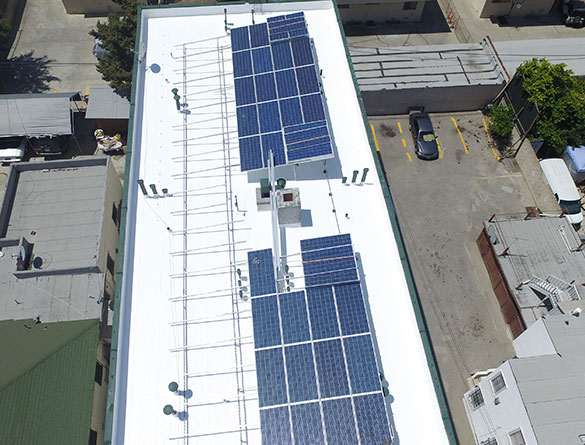
Commercial property owners and managers in Hidden Hills require roofing solutions that address specific local climate challenges while maintaining fiscal responsibility. American High Tech Roof Coatings Inc. specializes in the application of high-solids silicone roof coatings, a fluid-applied system designed to restore and protect existing commercial roof substrates. This process creates a seamless, waterproof membrane over the existing roof, eliminating the need for costly tear-offs and minimizing disruption to building operations.
The following information details the technical and financial aspects of silicone roof restoration for stakeholders in the Hidden Hills area.
Commercial Roofs Best Suited for Silicone Coating
Silicone coatings are chemically engineered to adhere to a wide variety of existing roofing surfaces. The material forms a chemical bond with the substrate, provided the surface is properly cleaned and primed where necessary. This versatility makes it a viable option for most flat and low-slope commercial roofs found in Southern California.
American High Tech Roof Coatings Inc. applies silicone restoration systems to the following substrates:
- Modified Bitumen (Mod-Bit): Granulated or smooth surfaces.
- Single-Ply Membranes: TPO (Thermoplastic Polyolefin), EPDM (Rubber), and PVC.
- Built-Up Roofing (BUR): Tar and gravel roofs (requires specific preparation).
- Metal Roofing: Corrugated or standing seam metal roofs.
- Spray Polyurethane Foam (SPF): Existing foam roofs requiring recoating.
- Concrete: Structural concrete decks.
Businesses and Buildings Suited for Restoration
In Hidden Hills and the surrounding Calabasas area, commercial zoning often interfaces with high-value residential and equestrian estates. This proximity necessitates roofing work that is low-noise, low-odor, and aesthetically clean. Silicone restoration is particularly effective for:
- Homeowners Association (HOA) Facilities: Community centers, gatehouses, and maintenance structures.
- Office Parks and Medical Buildings: Facilities where noise from jackhammers used in tear-offs would disrupt business operations.
- Equestrian Centers and Barns: Metal roofs common on these structures benefit significantly from the rust-inhibiting and cooling properties of silicone.
- Retail Centers: Properties requiring minimal interference with foot traffic and parking during maintenance.
Comparison: Silicone Restoration vs. Traditional Re-Roofing
Property managers frequently decide between a full roof replacement (tear-off) and a restoration system. The table below outlines the operational and financial differences between these two approaches.
| Factor | Silicone Restoration (American High Tech Roof Coatings Inc.) | Traditional Tear-Off & Replacement |
|---|---|---|
| Cost | Significantly lower (material and labor savings). | High capital expenditure. |
| Project Duration | Rapid application, days or weeks depending on size. | Lengthy process, weeks or months. |
| Business Disruption | Minimal noise, building remains open and fully operational. | High noise, potential closure or restricted access. |
| Waste Disposal | Zero landfill waste. | Tons of debris sent to landfills, dumpster fees apply. |
| Risk Exposure | Building remains watertight during application. | Building interior exposed to elements during tear-off. |
Weather Considerations for Hidden Hills
The microclimate in Hidden Hills presents distinct challenges for roofing materials. The area experiences high solar loads, significant thermal fluctuations between day and night, and seasonal heavy rainfall.
Ponding Water Resistance
Flat roofs in the area often suffer from ponding water (water that stands on a roof for more than 48 hours). Acrylic coatings typically degrade under standing water, leading to peeling and failure. Silicone is inorganic and moisture-cured, meaning it will not break down, degrade, or dissolve when subjected to standing water. This makes it the primary recommendation for flat roofs with imperfect drainage.
UV Stability and Reflectivity
Hidden Hills experiences high UV index ratings. Traditional asphalt roofs absorb heat, causing thermal expansion and contraction that leads to cracking and leaks. White silicone coatings reflect up to 90% of UV rays. This reduces roof surface temperatures by as much as 50 to 80 degrees Fahrenheit, mitigating thermal shock and reducing cooling loads on the building's HVAC system.
Cost Benefit Analysis
Investing in a silicone roof coating system offers financial advantages beyond the immediate price difference compared to replacement.
Energy Efficiency
The reflective nature of the coating reduces energy consumption. By lowering the roof temperature, the intake air for rooftop HVAC units is cooler, and less heat transfers into the building envelope. This results in measurable reductions in summer electricity costs.
Tax Advantages and Depreciation
Roof restoration is generally classified as "maintenance" rather than a "capital improvement" for tax purposes. Under current tax codes, maintenance costs can often be expensed immediately in the year they are incurred (Section 179 deduction), whereas a new roof must be depreciated over 39 years. Property owners should consult their CPA to confirm specific eligibility.
Longevity: Extending Roof Life by 20 Years
A properly installed silicone system by American High Tech Roof Coatings Inc. effectively halts the aging process of the underlying roof membrane. The silicone layer acts as a sacrificial shield against the elements.
Standard material and labor warranties for these systems range from 10 to 20 years, depending on the thickness of the application (measured in mils). Once the warranty period concludes, the roof can typically be cleaned and recoated with a fresh layer of silicone to renew the warranty. This renewable lifecycle allows a commercial roof to remain functional indefinitely without ever requiring a full tear-off and replacement.