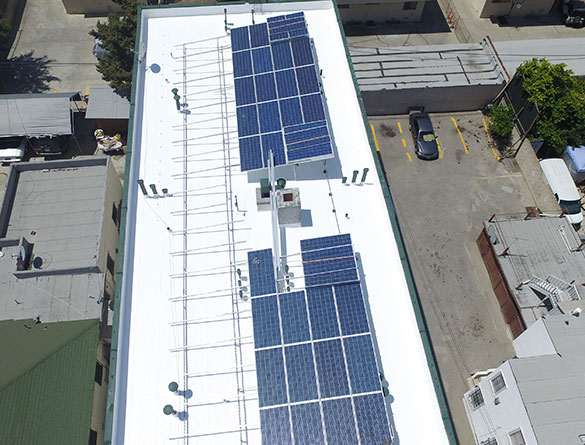
Commercial property owners and facility managers in Bradbury face specific challenges regarding roof maintenance due to the local climate and building regulations. American High Tech Roof Coatings Inc. provides high-solids silicone roof coating services designed to address these challenges. This process, often referred to as roof restoration, involves applying a liquid-based silicone membrane over an existing roof system. The material cures to form a seamless, water-resistant barrier that adheres directly to the current substrate. This approach offers a practical alternative to full roof replacement for buildings with structural integrity but aging surfaces.
Weather Considerations for Bradbury Properties
Bradbury experiences high temperatures and consistent solar exposure throughout the year. Ultraviolet (UV) radiation breaks down traditional roofing materials like asphalt and modified bitumen, leading to cracking, chalking, and seam failure. Silicone roof coatings are chemically inorganic, meaning they do not degrade under UV exposure in the same way carbon-based materials do.
The primary weather-related advantage for this region is thermal reflectivity. A white silicone coating reflects up to 88 percent of the sun's UV rays. This reduces the roof surface temperature significantly compared to a dark roof, which can reach temperatures exceeding 170 degrees Fahrenheit. Lower roof temperatures reduce the expansion and contraction cycles that cause leaks and structural fatigue over time.
Comparison: Silicone Coating vs. Total Re-Roofing
Restoring a roof with silicone is distinct from a complete tear-off and replacement. The following table outlines the operational and financial differences between the two methods for commercial structures.
| Factor | Silicone Restoration | Full Roof Replacement |
|---|---|---|
| Cost Efficiency | Generally 50 to 70 percent less than replacement. Costs are reduced by eliminating demolition and disposal labor. | Higher capital expense due to labor-intensive tear-off, material disposal fees, and new insulation costs. |
| Waste Management | Sustainable process with zero landfill waste. The existing insulation and substrate remain in place. | Generates significant landfill waste. Old materials must be hauled away and disposed of according to environmental regulations. |
| Installation Time | Rapid application. A typical commercial project takes days rather than weeks. | Extended project timeline depending on roof size and weather windows. |
| Business Continuity | Non-intrusive. Businesses remain open with minimal noise or odor disruptions. | Disruptive. Noise, heavy machinery, and potential closures often impact daily operations. |
Cost Benefit Analysis
Opting for a silicone roof coating system provides measurable financial advantages beyond the initial installation price.
- Energy Reduction: Due to the reflective nature of the coating, HVAC systems work less to cool the building interior. This typically results in a reduction of cooling energy costs during summer months.
- Tax Classification: In many accounting contexts, a roof coating is classified as "maintenance and repair" rather than a "capital improvement." This classification allows building owners to deduct the entire cost in the current tax year, whereas a new roof must be amortized over 39 years. Consult a tax professional for specific eligibility.
- Extended HVAC Life: Reduced intake temperatures on rooftop air conditioning units lower the strain on equipment, potentially extending the lifespan of the HVAC infrastructure.
Longevity: Extend the Life of Your Roof
Silicone roof coatings are designed to extend the service life of an existing roof by 10 to 20 years. American High Tech Roof Coatings Inc. applies the coating at specific millage thicknesses to warrant these lifespans. Because silicone is permanent and does not break down over time, it maintains its flexibility and waterproofing capabilities indefinitely.
At the end of the warranty period, the roof can typically be washed and re-coated with a new layer of silicone to renew the warranty. This cycle allows property owners to maintain the same roof substrate for decades without ever requiring a full tear-off.
Roofs Best Suited for Silicone Coating
Silicone is a versatile solid that adheres well to most commercial roof surfaces. It is an ideal solution for flat or low-slope roofs where ponding water is a concern, as silicone is one of the only coating materials that does not deteriorate under standing water.
The following substrates are excellent candidates for restoration:
- Metal Roofs: Silicone seals seams and fasteners, stopping rust and leaks instantly.
- Single-Ply Membranes (TPO, EPDM, PVC): Ideal for aging membranes that have started to chalk or shrink.
- Modified Bitumen and Built-Up Roofs (BUR): The coating seals cracks and prevents the asphalt from drying out further.
- Spray Polyurethane Foam (SPF): Protects the foam from UV degradation and physical damage.
Businesses and Buildings Suited for Service
In Bradbury, various commercial facilities benefit from this application. The process is particularly advantageous for buildings where internal climate control is critical or where business interruptions must be avoided.
- Warehouses and Distribution Centers: These large surface areas gain the most from energy savings and leak prevention.
- Retail Centers and Strip Malls: Installation occurs without disrupting tenant operations or customer access.
- Medical Offices and Healthcare Facilities: The low-odor application ensures patient comfort is maintained during the project.
- Office Parks: Property managers can restore roofs without capital expenditure budgets required for replacement.