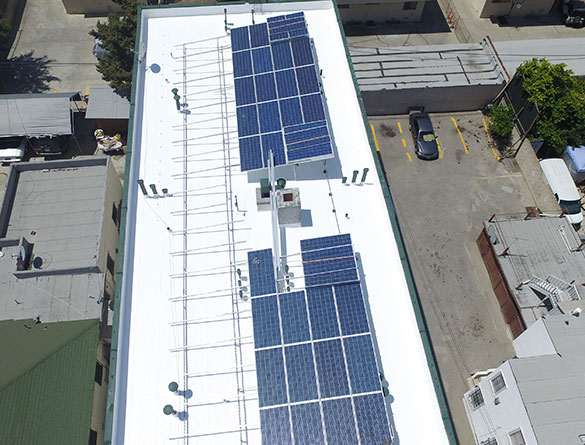
Commercial property owners in Commerce utilize silicone roof coatings as a restoration strategy to prolong the utility of existing roof structures. This fluid-applied system creates a seamless, monolithic membrane over the existing roof surface. American High Tech Roof Coatings Inc. provides this service to address common roofing failures, such as leaks, seam separation, and UV degradation, without necessitating a complete tear-off. The following information outlines the technical and financial parameters of silicone roof restoration.
Restoration vs. Re-Roofing: A Comparison
The primary alternative to applying a silicone coating is a complete roof replacement. Re-roofing involves removing the existing substrate, transporting debris to a landfill, and installing entirely new materials. Silicone restoration allows the existing insulation and deck to remain in place. The table below compares the operational and financial differences between these two approaches.
| Factor | Full Roof Replacement | Silicone Restoration |
|---|---|---|
| Cost Impact | High capital expenditure comprising labor, materials, and disposal fees. | Significantly lower cost per square foot, utilizing existing infrastructure. |
| Business Disruption | High disruption due to noise, debris, and potential facility closure. | Minimal disruption; business operations typically continue during application. |
| Waste Generation | Contributes significantly to landfill waste (insulation, membrane, metals). | Near-zero waste generation as the existing roof remains in place. |
| Project Duration | Weeks to months depending on square footage and weather. | Days to weeks, depending on surface preparation requirements. |
Cost Benefit Analysis of Silicone Roof Coating
The financial advantages of silicone roof coating extend beyond the initial installation savings. Silicone is a highly reflective material, typically white, which reflects UV rays rather than absorbing them. This reflectivity reduces the thermal load on the building, lowering the internal temperature and reducing the energy required for HVAC systems to cool the facility.
From a tax perspective, the classification of the project affects the bottom line. A full roof replacement is generally considered a capital improvement, which must be depreciated over 39 years. In contrast, roof restoration is frequently classified as maintenance and repair. Under current tax codes, maintenance expenses may often be expensed in the same fiscal year they are incurred. Property owners should consult with their tax professionals regarding Section 179 deductions relative to roof restoration.
Weather Considerations in Commerce
Commerce experiences distinct weather patterns that impact commercial roofing materials. The primary environmental stressor is prolonged exposure to ultraviolet radiation. Standard bituminous roofing materials degrade over time under UV exposure, leading to cracking and shrinkage. Silicone remains flexible and stable when exposed to UV radiation, preventing the brittleness that causes leaks in other materials.
Ponding water is another critical consideration for flat roofs. Many coating chemistries, such as acrylics, break down if water stands on the surface for more than 48 hours. High-solids silicone is inorganic and moisture-cured, meaning it is impervious to water. It maintains its adhesion and structural integrity even in areas where water accumulates due to drainage issues. This resistance to ponding water makes it uniquely suited for flat commercial roofs in the area.
Suitable Roof Types for Coating
American High Tech Roof Coatings Inc. applies silicone systems to a wide variety of commercial substrates. The material adheres well to surfaces that are structurally sound but require a new waterproofing layer. Compatible roof types include:
- Single-Ply Membranes: TPO, PVC, and EPDM roofs that have weathered but are not saturated with moisture.
- Modified Bitumen (Mod-Bit): Granulated or smooth surfaces can be coated to stop asphalt leaching and heat absorption.
- Built-Up Roofs (BUR): Gravel or smooth surfaced asphalt roofs.
- Metal Roofing: Silicone seals seams and fasteners, preventing rust and thermal shock movement.
- Spray Polyurethane Foam (SPF): Silicone acts as the protective shell for foam insulation.
Businesses & Buildings Best Suited for Application
The commercial and industrial density of Commerce includes specific building types that benefit largely from silicone applications. Large-scale warehouses and distribution centers often have vast expanses of flat roofing where tear-off costs are prohibitive. Silicone coating provides a viable budget alternative for these facilities.
Retail centers and office buildings also benefit due to the low-odor options available with solvent-free silicone. Since the application process is quiet and non-intrusive, retail tenants and office workers are not disturbed by the heavy construction noise associated with roof replacement. Cold storage facilities are also excellent candidates, as the reflective nature of the white silicone aids in maintaining lower internal temperatures, reducing the load on refrigeration units.
Longevity: Extend Life of Your Roof by 20 Years
A properly installed silicone roof coating system effectively renews the warranty and service life of a commercial roof. American High Tech Roof Coatings Inc. installs systems capable of extending roof life by up to 20 years. The thickness of the applied coating, measured in mils, correlates directly to the warranty length.
Once the coating reaches the end of its lifecycle, the roof does not necessarily require removal. Silicone is a renewable system. By cleaning the existing silicone surface and applying a new topcoat, the warranty and protection can be extended for another term. This cycle allows a roof to remain functional indefinitely, provided the substrate remains dry and structural integrity is maintained.